
In Conversation: Odile Gakire Katese and Ross Manson
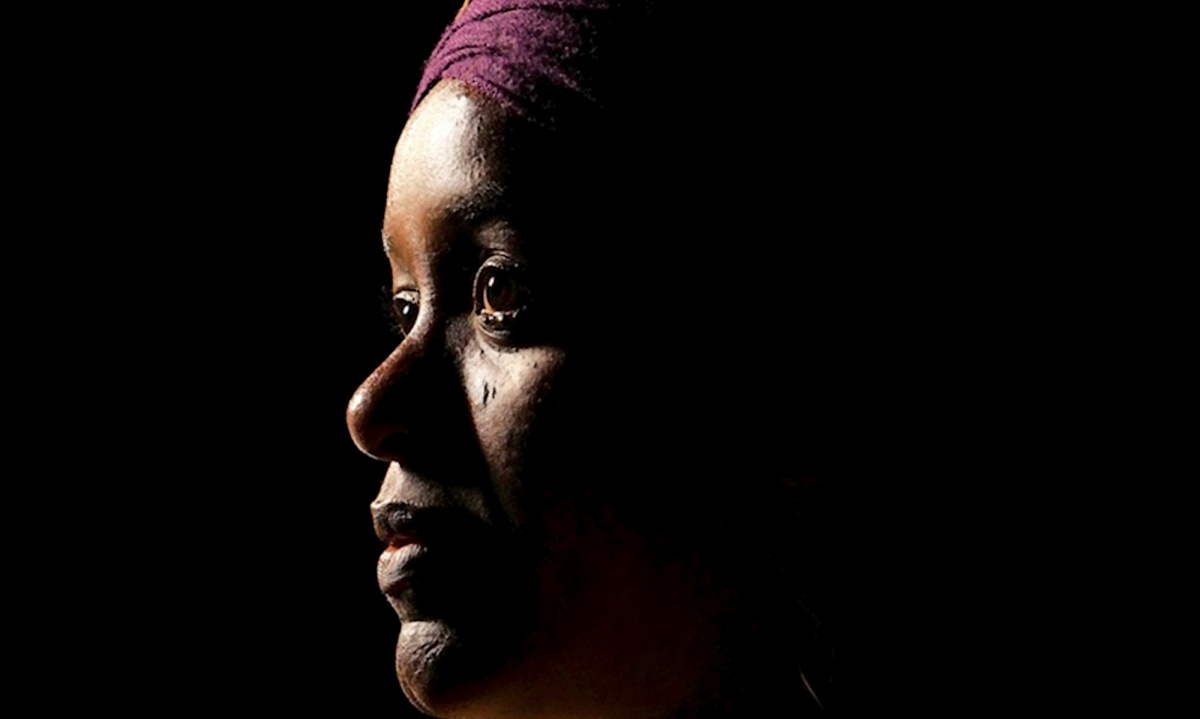
Rwanda, 1994: One million people are murdered in 100 days. 25 years later, the country and the world are still grappling with the fallout of such earth-shattering fear and hatred. How do we come back from this unthinkable? What happens after the undoable is done?
In this world premiere of The Book of Life, co-creators Odile Gakire (Kiki) Katese (also writer and performer) and Ross Manson (also director) seek healing after loss. By collecting and sharing letters from survivors and perpetrators of the Rwandan Genocide, The Book of Life attempts to bridge the gap between those departed and those left behind.
It’s definitely not an easy topic, but Kiki and Ross share their philosophies on the healing power of letters and new ways of humanizing and celebrating those lost to horrific violence.
The Book of Life is a Volcano Theatre production, in association with The Woman Cultural Centre, Rwanda and Why Not Theatre, and presented by Canadian Stage.
__________________________________________________________________
On how difficult it can be to understand the atrocities committed in 1994 as anything other than evil.
Kiki: For me, [evil is] anything that hurts anyone. I feel like, in which context are you going to justify [hurting someone]? How do you know? Like the freedom of expression, the only limitation is as long as it doesn’t hurt. [Things] like killing and stealing are clear, it’s not acceptable to do those things. For me, anything that harms anyone would be evil.
Ross: Injustice drives me crazy. Injustice when people are murdered or belittled or have their rights taken away from them for no good reason, or the reason is self-aggrandizement. Misguided ideology that’s based in hate, these things are evil.
On the importance of healing in the wake of such evil, and theatre’s power to help with that healing.
K: In The Book of Life there’s an opportunity there onstage to re-invent things; to dream; to try to undo something; and to propose for a moment another point of view, another way of the re-visiting the past. Re-visiting the atrocities that happened and find a way to undo them. I’m obsessed with this word of undoing. It’s not possible to do that in real terms, but in symbolic terms through the letters that people wrote. It’s like a ceremonial way to just rehabilitate life.
R: I believe that everything is story. We are made up of stories, the stories that we carry around in our heads invent us and put the world around us into reality. What Kiki’s doing is infiltrating one story with another story; infiltrating another story. I think it’s a really useful idea in the world that we live in today because there’s been so much loss of story, or erasure of people either literally or figuratively. Dictatorships that want to get rid of stories. Colonial powers that want to get rid of the people that they’re subjugating. We’re at a point now where there are very powerful dominant stories in play. But there is nothing more powerful than tiny little stories that infiltrate a dominant story and change it greatly. This has happened time and again in human history. So what Kiki is doing with this genocide is infiltrating it with another story—which is a story that’s actually very useful and I think positive and healing.
On the act of letter writing being central to the creation of The Book of Life, helping to reframe the atrocities and bring the humanity of the victims to the forefront.
K: Ultimately it’s a way of capturing life and rehabilitating the victims of the 1994 genocide as human beings. So they aren’t confined in a box as victims, they are not just bones, they are not numbers. Something horrific has happened and [the letters are] putting faces [to it,] trying to recreate and bring them back to life as a human beings so that they don’t vanish. I think this is one of the many ways I can be there to capture something that’s not vanished yet. This act of remembering, if you don’t pay attention at a certain point it will be empty. I hope the letters capture something of the people who disappeared so that they don’t vanish, availing these stories among other stories. These narratives need to be told and the truth be there for the next generations.
R: The magic of the letter-writing is that it’s such an approachable form, and it’s a form that I think instantly erases differences. We all understand if you write a letter to your mom or letter to your kid or your uncle or whoever; it’s something that we can imagine doing very easily and therefore the difference between us and the person writing that letter vanishes almost instantly. Kiki came [to Volcano Theate] last year to do a masterclass on this letter writing technique she’s come up with. The students (most of them professional theatre artists) were a mix of Indigenous people, and settlers, and Métis, people of colour and dominant culture people. We all wrote these letters together and it was astonishing how it’s like a fast forward through all of these differences to a place of commonality.
On women’s voices being integral to the telling of this story.
R: The whole project is permeated with women’s voices, and Kiki’s life project has been bringing women’s voices to the fore in Rwanda. Kiki founded the first ever professional women’s drumming group in a country where women were forbidden to touch the drum. It’s an incredibly bold, kickass act! The women drummers worked on this with us. All of the voices in this are women’s voices. It’s pretty amazing.
On how artists can reframe trauma through storytelling, addressing it without retraumatizing survivors of violence.
R: What Kiki is doing with the Rwandan Genocide is to put it in an imaginative place that is not traumatizing. [Kiki] told me before that the kind of art she was making before was retraumatizing. It was the kind of art that many artists do, processing enormous loss, pain, and hatred by replicating that onstage. And people who have gone through similar experiences are retraumatized. Kiki decided we’ve had enough trauma, so this switch in her art making has created a new approach. It’s created an imaginative space that the audience member can enter and find a way to move forward.
K: Is it possible to meet the victims before they die and stay there? We’ve archived death with our many memorials. When the genocide happened, I was in Congo in exile. So when I came back the only thing I knew about the victims was how they died. If this is the only memory I am going to keep, it’s going to be a very traumatized one. I think it’s very important as an artist—I learned that onstage—that I can create things. I learned to start from nothing and after a few weeks and rehearsals something was there. So if I start from the nothing of the genocide, can I pull life? As an artist, I always feel like a small god that can create something. And in this thinking, I can create reconciliation.
R: The most successful theatre performance experiences are when you feel captured as an audience. When the magic of a live performance has opened up this space for you to sit in something, where you don’t have to make up your mind or even know what you are feeling. That’s the beginning of a shift in a person, in their whole life potentially, and that’s what I hope for from The Book of Life.
K: It’s important to remind people that before they [Rwandans] were killed, they were people. If we only remember how they died, the attention is not put on the victim, it’s put on the perpetrator. It’s important that we archive life. This is my way to mourn and to leave a legacy that is not made of pain and despair, one that is peaceful where we can feel good. I want the play to be something we look forward to. In the darkness we are all there with our loved ones, and in this we can make peace and all prevail!
The Book of Life plays at the Marilyn and Charles Baillie Theatre (26 Berkeley St.) Sept. 17-29. Tickets can be purchased here.
Robyn Grant-Moran
Robyn Grant-Moran (Métis Nation of Ontario) is a classical singer, writer, and a jack of many trades who has recently met the requirements to call herself a Bachelor of the Fine Arts (thank you, York University and Indspire!). Along with her BFA, she has also completed the Performance Criticism Training Program with Generator, has studied with some beloved Canadian classical singers, and been in a opera or two. Robyn currently resides in Toronto with her tiny adorable rat dog.
LEARN MORE iPhoto caption: Festival artwork by Mishiikenh Kwe.
Weesageechak Begins to Dance invites artists and audiences to explore newness together
Weesageechak Begins to Dance is the annual festival of new and innovative First Nations, Métis, and Inuit theatre, opening on November 6 at Native Earth Performing Arts.
 iPhoto caption: Photo by Mike McPhaden.
There is a rift in the time-space continuum at Withrow Park this summer: multiverse Richard III has met Shakespearean universe Richard III for a coronation and some Shakespearean hijinks.
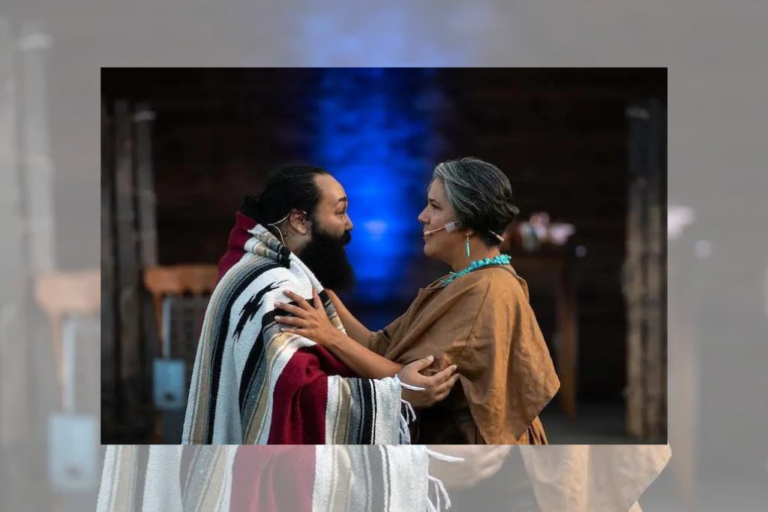
REVIEW: Otîhêw at Shakespeare in Action
A volcanic eruption and violent colonial expansion has turned the world upside down. Without sun and moon, the realities of famine and smallpox unleash new fears that threaten to unravel the fabric of community.
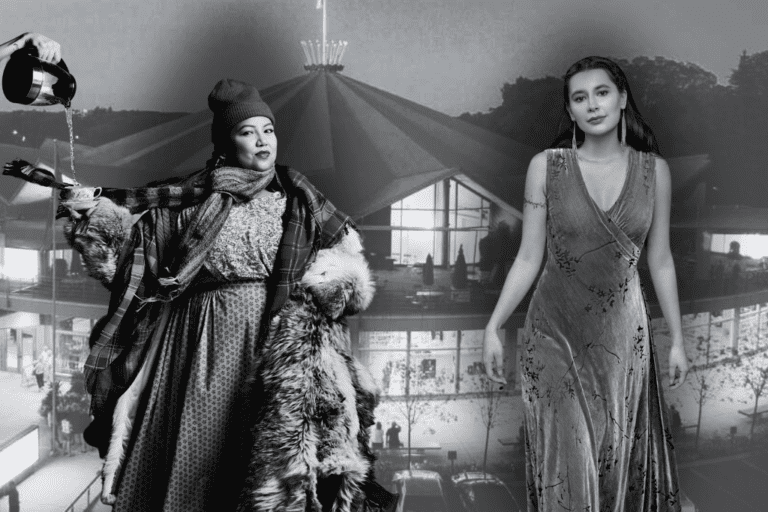 iPhoto caption: Joelle Peters (left) and Tara Sky (right). Original images of Peters and Sky by Ted Belton.
Change for the Better: On Indigeneity at the Stratford Festival
Both [Sky and Peters] want to honour the Indigenous artists who have worked with the [Stratford] festival for years, quietly carving out space for public and visual representation.
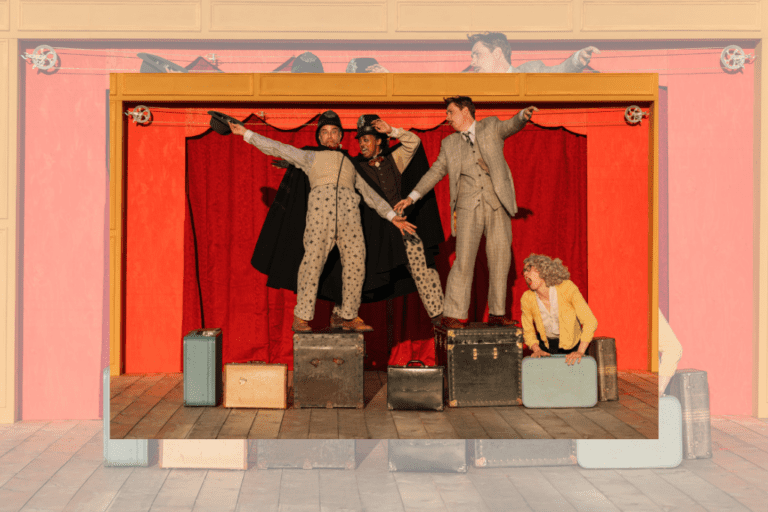 iPhoto caption: Courtenay Stevens, Helen Belay, Brandon McGibbon, Courtney Ch’ng Lancaster perform in The 39 Steps. Photo by Sarah Kirby.
REVIEW: The 39 Steps at County Stage Company
A cast of fantastic actors takes you on an equally fantastic journey through some of the silliest places and situations — it’s great fun.
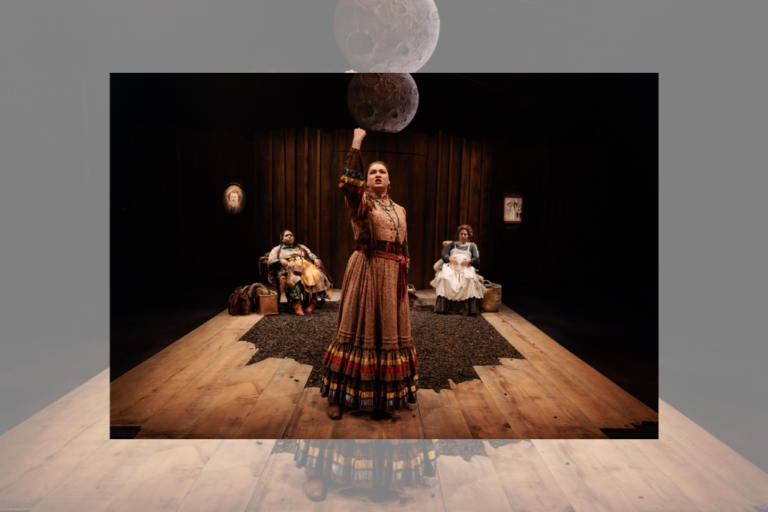 iPhoto caption: Photo by David Hou
REVIEW: Women of the Fur Trade at the Stratford Festival
Louis Riel is SO dreamy. Tall. A little disheveled and unkempt, because he’s an introspective poet who’s busy fighting for social justice. And he wears glasses. He’s the total package.
Comments